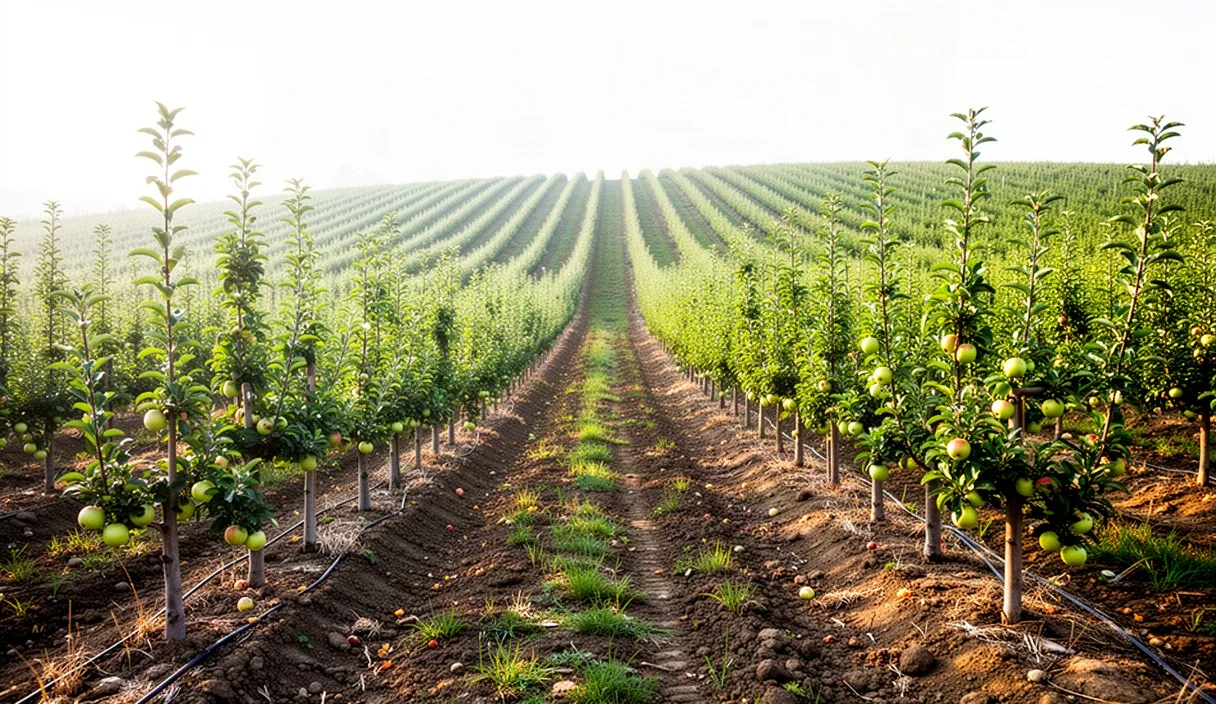
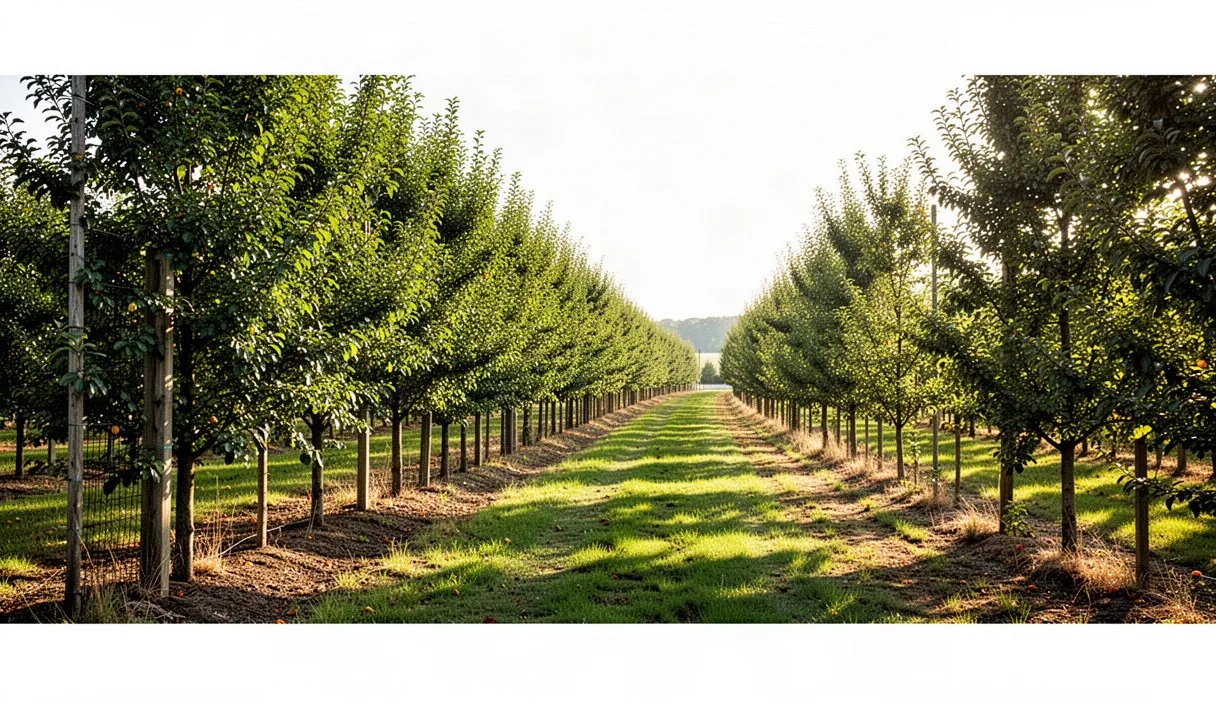

High winds snap graft unions, distort canopy architecture, and strip pollinating insects from blooming orchard blocks. Young fruit trees planted on exposed sites spend their first three seasons expending energy on structural anchor wood and bark thickening rather than lateral branching and early fruiting wood. Planting a planned, multi-row shelterbelt reduces mechanical wind stress, cuts soil moisture evaporation, and raises the ambient temperature of the orchard floor by two to three degrees during critical spring frost events.
A functional windbreak is an engineered biological screen, not a solid wall. The design demands an understanding of boundary layer physics, proper species composition, and deliberate below-ground management to prevent the windbreak itself from mining nutrients and moisture from the target crop. By laying out the shelterbelt across the prevailing wind vectors before or during orchard establishment, you create a microclimate that protects trunk caliper growth and fruit set throughout the orchard lifecycle.
Aerodynamics of Permeable Shelterbelts
Solid barriers such as masonry walls or dense board fences force moving air masses upward, creating a low-pressure vacuum on the leeward side. This pressure differential pulls the displaced air back down in violent, turbulent downdrafts within a distance equal to three to five times the wall height. A biological windbreak operates by friction rather than redirection. It bleeds kinetic energy from the airflow, allowing roughly 40 percent to 45 percent of the wind volume to pass through the canopy at a dramatically reduced velocity.
The protected zone of a permeable shelterbelt extends downwind across a distance 20 times the height (20H) of the mature trees, with the maximum speed reduction occurring between 4H and 8H. Within this primary zone, wind speed drops by 60 percent to 75 percent. Beyond 12H, velocity climbs steadily until ambient surface speeds return near 25H. On the upwind side, wind resistance begins to slow incoming gusts up to 2H to 3H ahead of the physical barrier.
| Barrier Permeability | Leeward Protected Zone | Turbulence Risk Level | Primary Failure Mode |
|---|---|---|---|
| Dense (Under 20 percent porosity) | Short (8H to 10H) | Severe leeward eddies | Structural limb breakage behind barrier |
| Optimal (40 to 50 percent porosity) | Extended (20H to 25H) | Minimal laminar flow | None; continuous speed reduction |
| Open (Over 65 percent porosity) | Insignificant (under 5H) | None | Insufficient velocity drop |
Achieving this 40 percent to 50 percent porosity requires layering deciduous and evergreen species. Pure conifer screens become too dense as they mature, acting like solid walls in late autumn and winter. Deciduous species lose their foliage in winter, which keeps porosity functional during dormant-season storms while maintaining dense, leafed-out resistance during late spring blossom and summer fruit load.
Selecting Native Species for Outer and Inner Rows
A multi-row shelterbelt uses a stepped profile to lift wind currents gradually. The windward, outer row confronts the raw force of seasonal gales, catching debris and drifting snow. The inner rows lift the airflow higher and establish the canopy density required to diffuse the gust. Selecting species native to your region guarantees drought hardiness, cold acclimation, and resistance to endemic soil pathogens.
The outer row requires tough, low-stature woody shrubs or small trees with high stem flexibility and multi-stemmed growth habits. Species such as American plum (Prunus americana), chokecherry (Prunus virginiana), or hazelnut (Corylus americana) break wind speed at ground level and hold snow loads without snapping. For arid Western sites, fourwing saltbush (Atriplex canescens) or buffaloberry (Shepherdia argentea) provide dense, low basal coverage. Never choose species that act as alternative hosts for orchard-specific pests or pathogens; avoid planting cedar species near apple orchards to stop the lifecycle of cedar apple rust (Gymnosporangium juniperi-virginianae).
The middle and inner rows should alternate fast-growing tall deciduous hardwoods with moderate-growth conifers. Eastern white pine (Pinus strobus) or Douglas fir (Pseudotsuga menziesii) paired with green ash (Fraxinus pennsylvanica), hackberry (Celtis occidentalis), or bur oak (Quercus macrocarpa) construct a durable, long-term barrier. Plant fast-establishing species, like hybrid poplar or willow, only as temporary nurse trees with the intention of roguing them out after seven to eight years to prevent aggressive underground competition.
- Row One (Windward): Multi-stemmed native shrubs spaced four to six feet apart.
- Row Two (Center): Tall native conifers spaced eight to twelve feet apart.
- Row Three (Leeward): Long-lived deciduous hardwoods spaced ten to fourteen feet apart.
Calculating Buffer Distances from Orchard Boundaries
The single greatest operational mistake in shelterbelt design is planting windbreak rows too close to the first production row of fruit trees. While proximity reduces wind damage on that immediate edge, it triggers severe competition for photosynthetically active radiation and underground water. In northern latitudes, shadow length during the spring equinox dictates east-west orientations, while prevailing summer storm fronts dictate south-west windbreaks.
Calculate your orchard buffer zone using the anticipated mature height (H) of the tallest shelterbelt row. Set the buffer space at a minimum distance equal to 1.5H to 2H from the centerline of the windbreak to the first fruit tree row. If your tallest conifer matures at 50 feet, leave an open alley of 75 to 100 feet. This alley accommodates farm equipment turns, spray tractor drift turnarounds, and provides a drainage sink for cold, dense air on radiative frost nights.
Cold air behaves like liquid, draining downhill along topographical slopes. A windbreak planted across a slope without drainage gaps traps cold air behind it, forming a frost pocket over adjacent fruit blocks. If your boundary crosses a grade, stagger gaps in the tree line at an angle oblique to prevailing winds. This allows descending cold air masses to slip through without opening a direct wind tunnel into the orchard block.
Root Pruning Techniques to Prevent Water Theft
Forest trees send feeder roots two to three times the distance of their drip line. In arid or un-irrigated ground, an unmanaged windbreak will mine water from adjacent drip lines, stunting young fruit trees and reducing fruit size on mature wood. Deep root pruning cuts lateral feeder roots near the orchard boundary, driving shelterbelt roots downward into deeper subsoil strata and keeping the top 24 inches of orchard soil reserved for the cash crop.
Establish a root-pruning trench running parallel to the shelterbelt, positioned halfway between the windbreak drip line and the first fruit tree row. Use a tractor-mounted subsoiler shank, ripper tooth, or vibratory plow blade capable of slicing through soil to a uniform depth of 30 to 36 inches. Execute this mechanical severance every two to three years, beginning in the fourth year after windbreak planting.
- Locate the cut line: Stake a line parallel to the inner windbreak row, at least 15 feet outside the shelterbelt's mature drip line.
- Check soil moisture: Pull a soil core from the 18-inch horizon; perform subsoiling only when soil is dry to slightly damp to ensure clean root cuts rather than tearing and soil compaction.
- Rip the boundary: Lower the single subsoil shank to 32 inches and pull along the marked boundary line at two to three miles per hour.
- Pack the seam: Run a heavy tractor wheel directly over the sliced seam to eliminate subsoil air pockets and collapse vertical voids that dry out cut roots.
Conduct root pruning in early spring before bud break or in late autumn after leaf drop. Pruning during midsummer causes sudden hydraulic stress to the shelterbelt canopy, triggering defoliation or crown dieback in drought conditions. If you are uncertain about subterranean utilities, drainage tiles, or bedrock depth, consult a regional soil conservation technician before running deep subsoil equipment.
Maintenance Protocols for the First Three Years
A windbreak must grow fast to provide shelter to young fruit trees within their vulnerable training period. Young stock neglected during the first three seasons suffers from heavy grass competition, rodent girdling, and desiccation. Implement a strict maintenance routine to secure rapid establishment and high survival rates across all species.
Control weed competition within a four-foot radius of every seedling. Grass and perennial broadleaf weeds consume surface moisture and harbor voles (Microtus species) that chew through root collars under winter snow cover. Lay down a six-foot wide strip of heavy, woven black polypropylene landscape fabric along each windbreak row, securing edges with 8-inch steel sod staples every three feet. Alternatively, maintain a clean-cultivated strip with shallow rototilling or approved post-emergent herbicides.
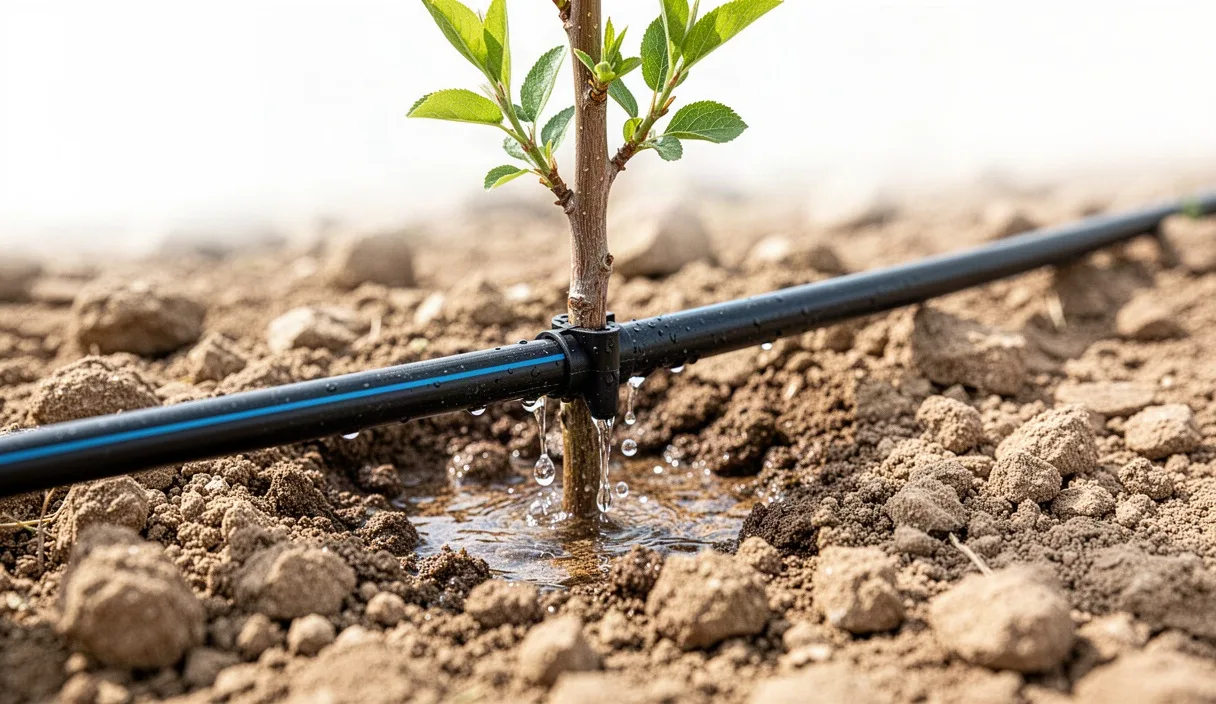
Install rigid, mesh plastic trunk guards around every deciduous tree seedling immediately after planting to deter rabbits and rodents. For conifers, apply organic-certified repellent sprays containing putrescent egg solids during early spring and late autumn to deter deer browsing. Provide supplemental drip irrigation during seasons one and two: run lines delivering five to ten gallons of water per tree every seven to ten days when summer precipitation drops below one inch per week. Discontinue supplemental water by late August to allow new vegetative growth to harden off before early autumn hard freezes.
Common Mistakes
Avoid these layout errors that compromise orchard health and long-term operations:
- Single-species monocultures: Planting an entire perimeter in a single species, such as Leyland cypress or green ash, leaves the entire windbreak vulnerable to total destruction from targeted pests like the emerald ash borer or regional canker outbreaks.
- Planting in straight solid blocks without machinery access: Failing to include service gates, turnarounds, and mow strips turns the buffer into an unmanaged brush zone full of invasive weeds.
- Neglecting cold air drainage: Damming cold down-slope air on frost-prone hill faces by failing to angle shelterbelt ends, converting a mild site into an artificial frost pocket.
- Over-irrigation past establishment: Irrigating the windbreak heavily past the second year encourages shallow root systems that run toward orchard irrigation emitters instead of driving roots deep into subsoil.
Practical Next Steps
Begin shelterbelt planning at least 12 months before placing tree orders for your production orchard block. Obtain historical wind data from your closest airport or state agricultural weather network; determine both the prevailing direction of high-velocity drying winds in summer and damaging cold fronts in early spring. Order your bare-root windbreak seedlings from state forestry nurseries or commercial conservation nurseries in autumn for late winter or early spring delivery.
Ground preparation must happen the autumn prior to planting. Rip the planting rows, clear perennial weed rhizomes, and apply necessary lime or organic soil amendments based on a comprehensive soil assay. Staking and mapping the boundary rows with surveying flags prevents installation errors and ensures your buffer distances meet operational spray equipment clearances.