
Spring planting decisions determine the trajectory of a stand for decades. Landowners, foresters, and orchardists face an immediate operational choice between dormant bareroot seedlings and containerized plug stock. Neither stock type fits every site condition, soil texture, or budget. Selecting the wrong seedling format wastes capital, squanders field labor, and leads to unacceptable mortality during the first summer drought.
The choice hinges on verifiable trade-offs between root morphology, logistical limits, and labor capacity. Bareroot stock offers lower unit costs and natural root orientation, but demands strict dormancy management and meticulous handling. Containerized seedlings deliver higher planting speeds and better tolerance to delayed planting dates, yet carry higher freight costs and face soil interface challenges in dense native clays. Evaluating both systems requires looking directly at operational data rather than nursery marketing claims.
Root Architecture and Soil Contact Mechanics
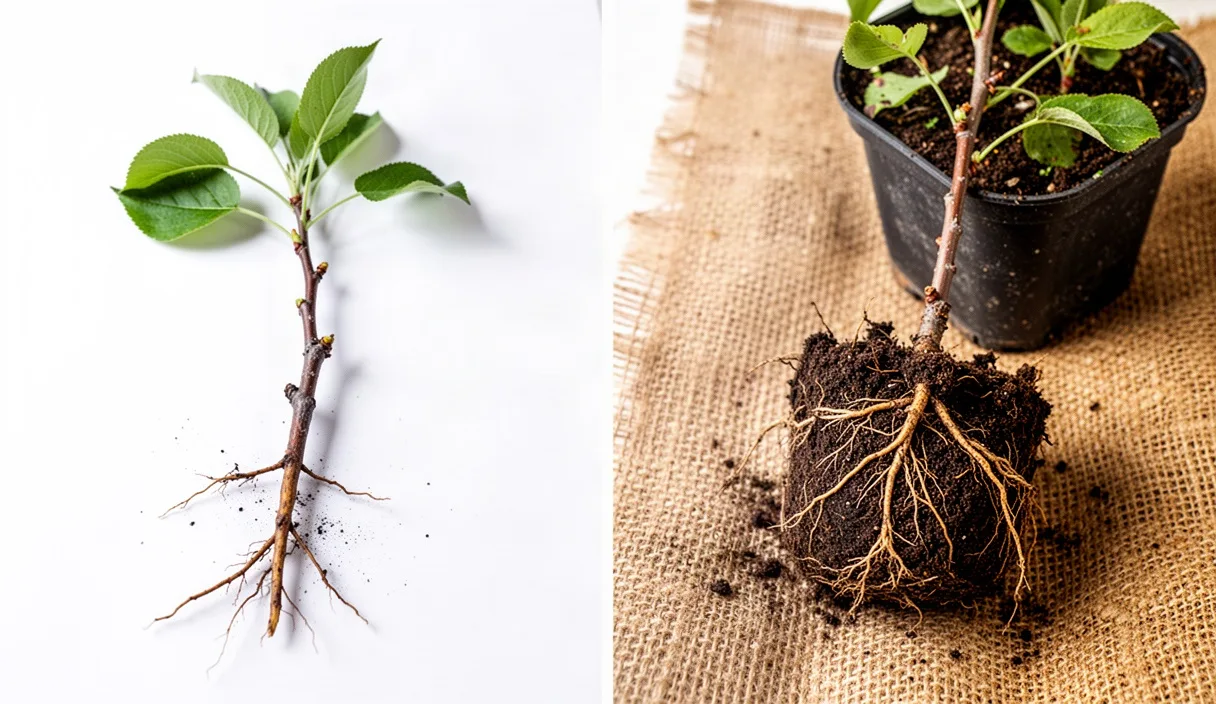
When a bareroot seedling is lifted from the nursery bed, it loses up to 85 percent of its fine root hairs and lateral feeders. What remains is the structural taproot and primary lateral roots. When planted into correctly prepared soil, these roots establish direct, unmediated contact with the native soil matrix. There is no intermediate potting media to create a textural disparity. The seedling immediately depends on the capillary draw of the surrounding ground for moisture. If the planter cuts or bends these roots to force them into a shallow hole, the seedling develops J-rooting, a mechanical defect that strangles vascular flow and creates structural instability ten or fifteen years later.
Containerized seedlings arrive with an intact root plug encased in an artificial medium, typically a peat-vermiculite or bark blend. Modern nursery containers incorporate vertical internal ribs that direct root tips downward, preventing the destructive girdling common in smooth-sided pots. As root tips reach the drainage holes at the bottom of the cell, ambient air prunes them, triggering lateral branching throughout the plug cavity. The resulting root ball is dense and resilient against initial transplant shock, retaining intact fine root hairs that continue drawing moisture immediately after installation.
However, the difference in texture between the plug medium and native field soil introduces a hydraulic obstacle known as a capillary break. Water does not move readily across the boundary between coarse, peat-rich container media and fine native silt or clay until the surrounding soil approaches full saturation. In drying spring conditions, this phenomenon works in reverse: the dry native soil can wick moisture out of the porous container plug, dehydrating the core of the root ball even when the plant appears firmly set. To prevent this, planters must ensure native soil covers the top of the plug by at least 15 millimeters, preventing the media from acting as an evaporative wick.
Moisture Stress and Transport Logistics
Bareroot stock is acutely sensitive to air exposure. Fine roots left uncovered in moderate wind (over 15 kilometers per hour) and modest sunlight can dry out in under three minutes. Once exposed roots despoil, the seedling cannot easily regenerate the cells needed to absorb water during the first critical weeks. Bareroot transport requires a continuous cold chain maintained between 1 and 3 degrees Celsius, paired with high relative humidity inside sealed, wax-lined bags or insulated boxes. If stored above 4 degrees Celsius, seedlings break dormancy prematurely, burning non-structural carbohydrate reserves needed for root initiation.
Containerized seedlings show higher tolerance to short field delays. Because their root systems remain insulated within moist media, plugs can sit on delivery pallets for several days without significant degradation, provided the crates receive shade and regular irrigation. This buffer allows plantation managers to navigate erratic weather patterns or equipment breakdowns without losing thousands of dollars in nursery stock.
| Logistical Factor | Bareroot Stock (1+0 or 2+0) | Containerized Stock (Plugs, 80-150cc) |
|---|---|---|
| Shipping volume per 10,000 stems | Approximately 1.2 cubic meters | Approximately 4.8 to 6.2 cubic meters |
| Weight per 1,000 plants | 18 to 32 kilograms | 70 to 115 kilograms |
| Storage temperature threshold | 0.5 to 2.5 degrees Celsius | 2.0 to 7.0 degrees Celsius (short-term) |
| Maximum holding time on site | 24 to 48 hours without refrigeration | 7 to 10 days with shade and water |
| Root exposure limit during handling | Under 180 seconds | Protected by media plug |
The transport density favors bareroot stock by a wide margin. A standard pickup truck or cargo trailer can carry 15,000 bareroot hardwood or conifer seedlings without exceeding weight or volume capacities. The same vehicle can haul barely 3,500 containerized seedlings of equivalent stem height before running out of volume. For remote planting sites accessible only by narrow logging tracks or utility vehicles, freight volume dictates whether stock arrives in a single trip or requires constant, fuel-intensive shuttles.
Planting Windows and Weather Vulnerability
Bareroot stock demands exact timing. Field planting must begin as soon as the soil thaws and drains sufficiently to prevent compaction, and it must conclude before the seedlings break terminal bud dormancy. In most temperate regions, this opens a tight window of three to five weeks between mid-March and late April. Planting bareroot stock after leaves or needles begin expanding causes rapid water deficit, because the stripped root system cannot meet the transpiration demands of growing foliage. If spring rains stall operations, unopened bags of bareroot stock face mold accumulation, root decay, and fatal carbohydrate depletion.
Containerized seedlings widen the operational window. Because their root systems enter the ground functional and fully intact, plugs can go into the soil several weeks after local bud break occurs. Planting operations can safely run from early spring through late May or early June, provided soil moisture remains above permanent wilting points. On high-elevation or poorly drained sites where late snowmelt or standing water delays early equipment access, containerized stock is often the only realistic format.
Weather vulnerability during planting day also diverges sharply:
- Drying winds: Bareroot crews must carry seedlings in wet canvas buckets or insulated planting bags, pulling only one tree at a time directly before ground insertion. Containerized systems allow the use of field trays where plugs remain safe until release into the planting tube.
- Late frosts: Intact container stock weathers sudden temperature drops with less physiological shock, as the root zone experiences minimal cellular disruption compared to newly severed bareroot stock.
- Saturated ground: Dibble tubes used for container planting handle damp soils efficiently, whereas planting spades used for bareroot stock often glaze the sides of the slit in saturated clay, creating a barrier to root emergence.
Cost Ratios and Labor Requirements per Hectare
Planting economics depend on the sum of nursery purchase price, shipping overhead, site preparation, and worker output. A typical commercial or conservation project aiming for 1,600 stems per hectare highlights these operational differences.
Containerized seedlings command higher nursery prices, typically running 35 to 65 percent more expensive per unit than equivalent bareroot stock of the same species and provenance. This markup reflects the nursery costs of greenhouse structures, media substrates, automated container filling, and bench space management. However, field labor dynamics frequently balance or reverse this gap on rocky, sloped, or slash-covered terrain.
Manual Labor Output
Planting tools dictate daily production rates. Containerized seedlings are routinely planted using hollow planting tubes such as the Pottiputki, paired with kidney-shaped carry trays. The planter drops the plug down the tube, triggers a foot lever to open the tip beneath the duff layer, and steps down to pack the soil around the extracted root ball. An experienced planter routinely sets between 1,100 and 1,800 containerized seedlings per eight-hour shift without excessive lower back strain.
Bareroot planting requires an L-notch, T-notch, or trench cut made with an open planting spade, mattock, or heavy planting bar. The operator must open the fissure, insert the root mass to its original root collar depth, spread the roots downward without bunching, withdraw the blade, and firmly heel-pack the opening to eliminate subsurface air pockets. Even experienced operators rarely exceed 650 to 900 bareroot plants per day on rough ground. When paying contract planting crews on a daily or hourly basis, containerized stock drops labor hours per hectare by roughly 45 percent.
Machinery and Furrow Planting
On smooth, flat agricultural ground converted to timber or windbreaks, tractor-mounted mechanical tree planters level the playing field. Tractor crews feed seedlings into mechanical packing wheels at rates exceeding 3,000 stems per day for both bareroot and container stock. Under these mechanical conditions, where labor bottlenecks disappear, bareroot stock provides superior economic returns because its low unit price dominates the project ledger.
Survival Data Across Three Growing Seasons
Field trials across temperate forest and restoration sites show that initial survival differences between bareroot and container stock narrow by the end of the third growing season, but their paths to stabilization differ based on soil type and seasonal precipitation.
| Stock Type & Soil Condition | Year 1 Survival | Year 2 Survival | Year 3 Survival | Mean Height (Yr 3) |
|---|---|---|---|---|
| Bareroot: Well-drained sandy loam | 88% | 83% | 81% | 94 cm |
| Container: Well-drained sandy loam | 93% | 89% | 87% | 102 cm |
| Bareroot: Heavy, compacted clay | 71% | 64% | 61% | 78 cm |
| Container: Heavy, compacted clay | 84% | 76% | 72% | 83 cm |
| Bareroot: Drought-prone rocky ridge | 63% | 52% | 48% | 65 cm |
| Container: Drought-prone rocky ridge | 79% | 71% | 67% | 76 cm |
In benign soils with consistent spring and summer rains, containerized plugs show an initial survival advantage of 5 to 7 percent during the first season. By season three, bareroot trees that successfully established taproots often match the annual growth increment of containerized trees. Because their roots directly engaged the native mineral soil from day one, their water access at deeper soil horizons matches or exceeds that of containerized root balls.
In harsh conditions, particularly compacted clays or shallow, drought-prone soils, containerized stock maintains an explicit survival advantage across all three seasons. The intact plug supplies critical water reserves during early summer dry spells, buying the plant time to push root tips out of the potting core and into the surrounding site. Bareroot stock placed in hard soils often succumbs to desiccating early heat before new root tips penetrate the compacted planting trench.
Common Mistakes
Failures with both stock types typically trace back to execution errors rather than biological defects in the planting stock.
- Pruning bareroot roots to speed planting: Planters frequently use shears or machetes to trim bareroot root systems down to 10 or 12 centimeters so they slip quickly into small slit cuts. Cutting large portions of the lateral root structure destroys stored energy and drops first-year survival rates by 30 percent or more. Holes must match the root system, not the other way around.
- Exposing container plugs above the surface: Leaving even one centimeter of peat plug exposed above the native grade creates a wick effect. The porous potting media pulls soil moisture toward the surface, evaporating it into the air and dehydrating the root system below ground. Plugs must be fully covered by native soil.
- Allowing root bags to heat in direct sun: Leaving bareroot delivery bags sitting on open ground in sunlight quickly raises internal temperatures beyond 20 degrees Celsius, cooking dormant roots inside their plastic-lined barriers. Store bags in continuous shade or insulated containers until the exact moment of field distribution.
- Over-compacting saturated clay around plugs: Planters stomping aggressively next to a newly inserted containerized plug in wet clay often form a dense, sealed collar. This smear layer hardens during summer dry-down, preventing lateral roots from escaping the plug boundary and stunting tree growth.
Practical Next Steps
To determine the correct format for your project, take these sequential actions before placing an order with a nursery:
Assess Soil Moisture Retention and Planting Windows: Determine whether your ground will be dry enough to plant during early dormancy. If heavy soils, late spring flooding, or snow access will push planting dates past early May, rule out bareroot stock immediately and book containerized plugs.
Audit On-Site Labor and Terrain: Calculate your workforce capacity. If relying on volunteer labor, small internal crews, or working on steep, stony ground, choose containerized stock paired with planting tubes to ensure high output and consistent planting depth. If contract hand crews are affordable or flat ground allows tractor-drawn transplanters, bareroot stock will lower overall per-hectare material costs.
Reserve Nursery Inventory Twelve Months Ahead: Commercial nurseries run out of favored seed zones and species early. Contact nursery managers a year prior to spring implementation. Specify root-collar caliper requirements (minimum 4 to 6 millimeters for bareroot hardwoods; 3 to 4 millimeters for conifers) and plug cell volumes (minimum 90 cubic centimeters for harsh or rocky sites) in your contract specifications.
Prepare Site Storage Infrastructure: Before delivery day, secure an on-site cold storage unit or a deeply shaded, rodent-proof staging barn. Arrange for adequate water access if handling containerized stock, and verify that all transport vehicles are clean and outfitted with heavy tarps to shield seedlings from highway wind-scour during transit.